
Project 2030
The distance crackdown set to begin with 2028's phased rollout appears headed for a two-year postponement.

The R&A and USGA issued a “Joint Statement of Principles” in 2002, suggesting “any further significant increases in hitting distances at the highest level are undesirable.”
At the end of the 2002 PGA Tour season, just one player averaged over 300 yards (John Daly at 306.8).
The average 2002 drive measured 279.5 yards.
Last year on the PGA Tour, 116 players averaged over 300 yards.
The stock drive flew 302.8 yards, 23.3 yard increase since 2002 and a 2.6-yard increase from 2024.
“Whether these increases in distance emanate from advancing equipment technology, greater athleticism of players, improved player coaching, golf course conditioning or a combination of these or other factors, they will have the impact of seriously reducing the challenge of the game,” said the still-posted 2002 statement. “The consequential lengthening or toughening of courses would be costly or impossible and would have a negative effect on increasingly important environmental and ecological issues. Pace of play would be slowed and playing costs would increase.”
All of that and then some happened.
Since the Joint Statement, the game saw a decline in players, only to see a post-pandemic surge. Neither participation swing can be traced to elite players adding 23 yards to their tee shots.
The two governing organizations eventually acted on the Joint Statement pledge in December 2023, and after allowing for feedback while following protocols agreed to by the industry, they gave golf equipment manufacturers until 2028 to begin a phased “rollback.” One where elite players would tee up with a shorter-flying ball, followed by the entire sport playing under revised testing parameters by 2030.
There are currently balls on the market that comply with the new ball testing rules, meaning the “billions” in R&D purportedly necessary for compliance turned out to be total nonsense. Yet the governing bodies will not tell us which balls on the current conforming list would be kosher in 2028.
Since making the decision, prototypes tested by elite players have prompted a few to already suggest that the intended impact of the new rules will fail to create consequential change for elites, with an even smaller impact expected for the average golfer.
“By the time we play these balls in 2028, there’s not going to be a difference,” Rory McIlroy said on the Fried Egg podcast late last year. “Or, the difference is going to be so marginal that it’s not going to make a difference.”
After the comment periods had sailed and the decision made following years of study, meetings, and consideration, there has been whining from the softest sport on the planet. Having not gotten their way but also never wanting to go into the rules business on their own, the PGA Tour and PGA of America have spread misinformation, ignored the protocols they agreed to, and have even peddled verifiable lies about the process. Much of this whining may be inspired by select manufacturers who are never happy. Coincidentally, they also forget that complying with the Rules of Golf is an entirely optional exercise. They are free to make non-conforming equipment.
And now it looks increasingly like the whingers will get their way. Again.
Last Friday, the USGA and R&A posted a notice on their websites asking the stakeholders if they would be willing to have another two more years to grovel, cook up flimsy reasons for another delay, and, in all likelihood, develop workarounds for the new Overall Distance Standard.
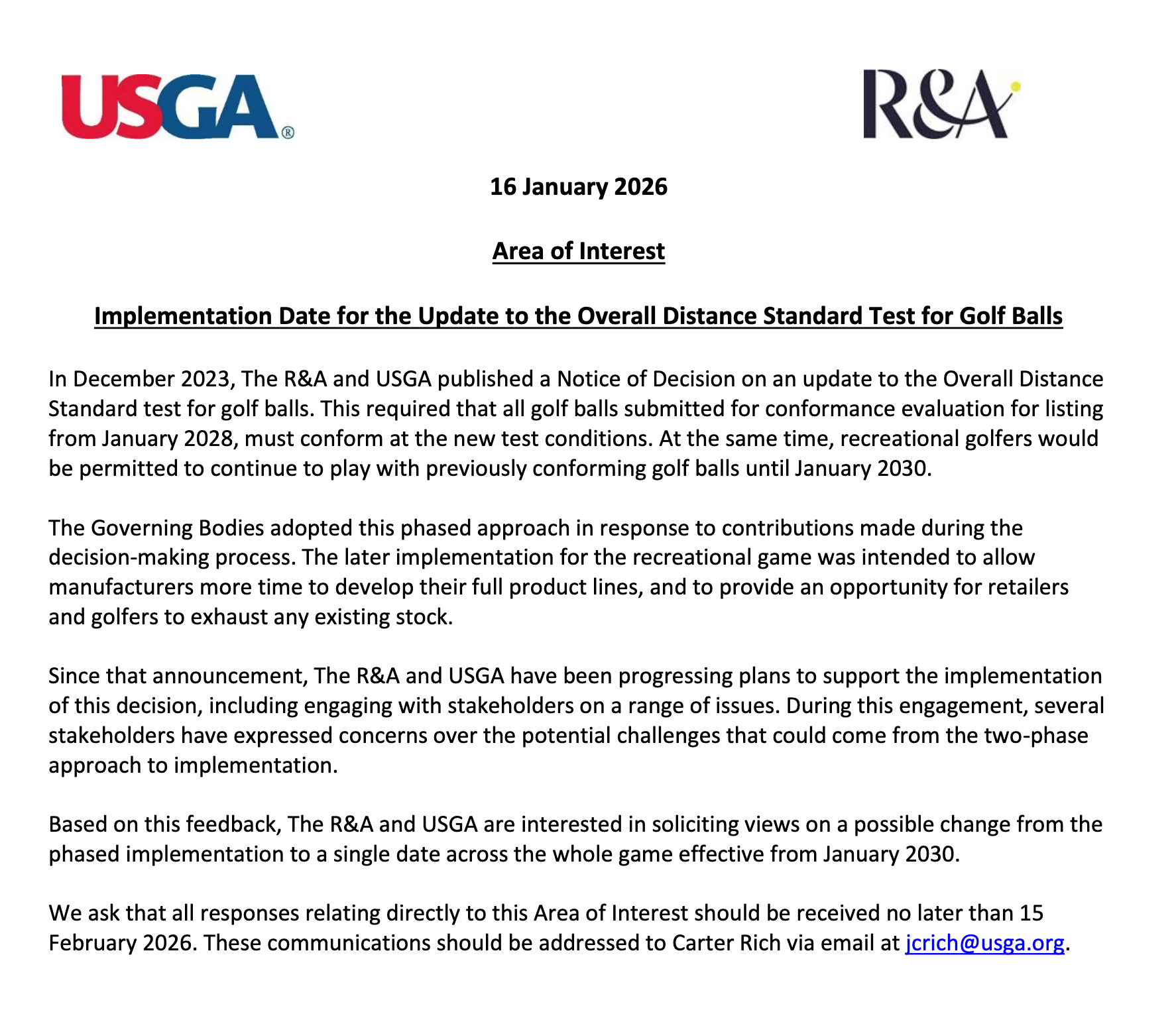
Why is there a need for another postponement after multiple years of study, notices, and other run-out-the-clock tactics? If the companies are already producing prototypes for player testing, then how come they can’t start ramping up for 2028 compliance while a grace period for average golfers is put in place? One similar to past equipment rule changes involving things like U-grooves?
The companies generally need two years to develop, manufacture and roll out a new a product line. They will end up getting six years if 2030 becomes the new date.
The manufacturers are in varying states of health despite record rounds and participation. Any claims that this is impacting their business would be absurd.
The latest Area of Interest notice may be less about manufacturing lead time and more about politics. The PGA of America has made a series of lame and even dishonest arguments. But implementation and enforcement of the two-phase rollout is the one area where they have a vested interest. Does the 2028 club championship use the Model Local Rule? And if so, who is going to make sure that Steve Sansabagger is not slipping in last year’s Pro-V1 instead of the new shorter flying version? Few PGA of America pros are paid enough to get in the middle of those petty disputes.
This would be a more relatable predicament had the governing bodies not already allowed the PGA of America and others to dictate a two-year postponement of the original implementation to 2028.
The Area of Interest notice also seems focused solely on the equipment makers and the needs of the PGA of America. But what about other interested parties?
The unwillingness by golf’s governors to wade into the golf course and injury issues related to the modern equipment continues to be one of the more bizarre conundrums surrounding distance discussions. From once-safe designs (or ranges) becoming unsafe due to longer tee shots and wider misses, to the more nuanced topic of pushing young players to chase speed via lighter equipment, to the general de-skilling effects producing a less complete game at the elite level, equipment rules should be much more significant matters than increasing distances nullifying course design strategy.
Since the whole thing still comes down to economics, the stakeholders who should have been notified are once again playing second fiddle to equipment makers who do not even constitute 10% of the golf economy. And who do the bare minimum to help the sport grow by offering more affordable beginner equipment.
