
May Gray
The trade sending the PGA Championship to May freed up August for the PGA "Playoffs". But the second major has yet to feel big, some of the Tour's best events have been weakened and ratings are down.

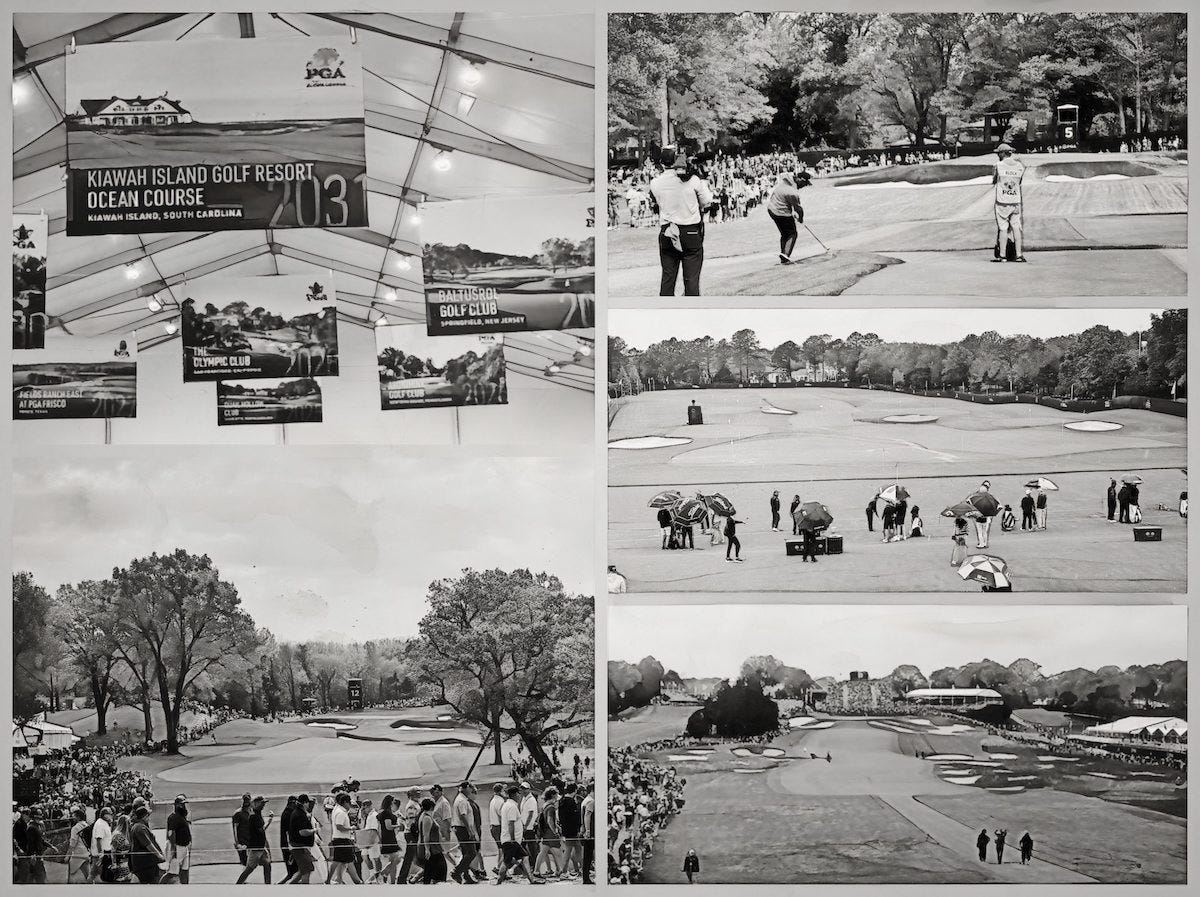
Some trades benefit both teams.
Sometimes, one side gets the better deal.
And sometimes the trading partners might have been better off not making a deal at all.
As the PGA Championship prepares for its seventh playing in May and the PGA Tour Playoff schedule is on the operating table, the trade between the Tour’s Jay Monahan and the PGA’s then-CEO Pete Bevacqua has no clear beneficiary.
Neither side is harping off the record to anyone who will listen that they were duped. But the date switch also hastened some of the headwinds faced by each organization. The Grand Slam season’s cadence seems too fast and just a bit off. The PGA Tour tournaments surrounding the PGA have been weakened, and the primary driver of the trade—the Tour’s season-ending playoffs—still lacks punch.
The Trade

The PGA of America’s PGA Championship would leave its traditional August date to give the PGA Tour’s expanded FedExCup playoffs a chance to shine. The Players would leave their 2007-18 May date and revert to March. The deal was initially driven by scheduling layers expected due to golf’s Olympic return. (The Games have turned out to be more of an annoyance for the Open Championship than tournaments in August.)
While the weather could be hot, the greens dead, and the fourth-of-four vibes strong, the PGA of America also owned early August on the American sports calendar. The organization sold its members on the May move by suggesting it would remind golfers of the PGA teaching pro’s value when springtime vibes were strong (hint, hint, take a lesson or get fit for new equipment). On the business side, the move to May was seen as a more lucrative sales opportunity ahead of the upfronts and before the fall when American football season sucked budgets dry. There were also claims that May was better agronomically and would open up other markets previously untenable in August.
The PGA Tour needed to free up August to boost “playoffs” that top players were understandably uninspired to play after the major season. It didn’t help to have a late August conclusion at East Lake, where the revitalization project was always envisioned as an October Tour Championship. And now college football has been creeping backward, with a huge opening weekend in Atlanta that has become another complication.
After six non-pandemic May PGA’s and with the PGA Tour possibly reimagining the playoffs again, there is good reason to assess how the deal has played out and whether a new trade could help either side.
Here’s a look at three key areas that drove the trade and how things have played out since 2019’s first May PGA.
The Courses
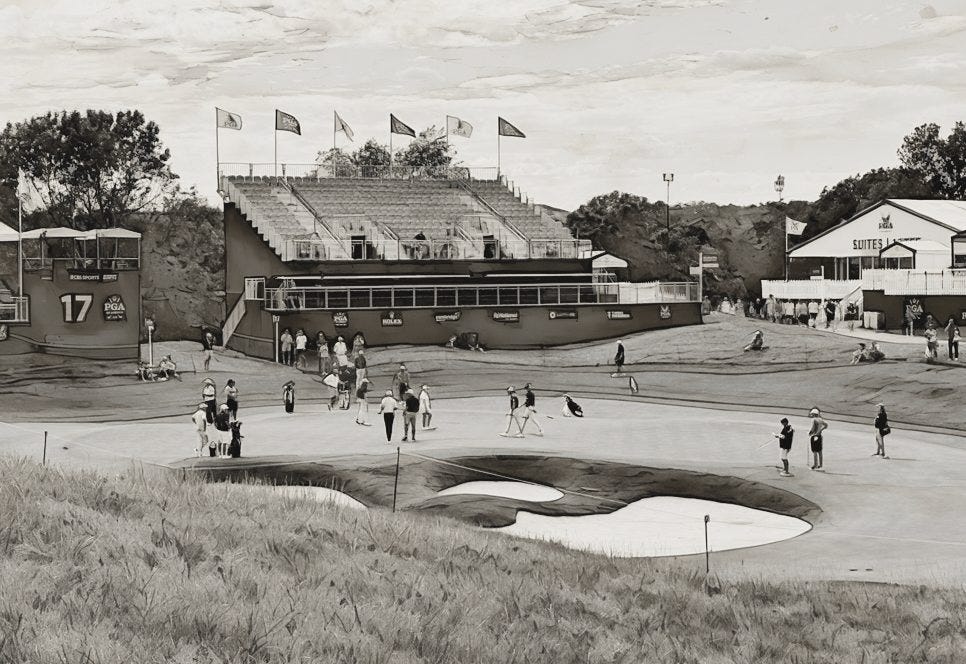
Hot and humid with the Weather Warning sign posted defined plenty of August PGA’s. Then again, when you go to St. Louis in August.
Before USGA greens and various advances in keeping turf alive during heat waves, greens wilted, and thunderstorms turned courses into pin cushions. A championship at Baltusrol spilled into Monday, and they played preferred lies for the first time in a major. The next time Baltusrol hosts in May 2029, the superintendent will face a different worry: getting enough warm weather to grow rough and to have the turf strong enough to push the greens. And hope for an absence of spring showers.
As Bethpage showed in 2019 and Aronimink is facing heading into next week’s PGA, superintendents are at the mercy of winter and spring weather. Aronimink’s Director of Agronomy, John Gosselin, sounds confident he’ll be able to put forward solid conditions. But with this winter’s 10 weeks of snow coverage and a cool spring, he’s understandably concerned about getting consistent rough or turf as firm and fast as everyone would like.
Apart from the 2021 PGA at Kiawah when weather and turf aligned to deliver a dream week, the superintendents will tell you it’s been touch-and-go leading up to Bethpage (2019), Southern Hills (2022), Oak Hill (2023), Valhalla (2024), and Quail Hollow (2025). Good weather in the last few weeks ahead of each masked stress for the supers. And all were softer than hoped-for. But compared to August, the Chief Championships Officer Kerry Haigh prefers the May date.
“The golf course conditioning has been probably better in May than August, dealing with the stress, the heat, and although it becomes sort of a tight window right before the third week in May,” he said at Valhalla. “We are delighted with what we’ve seen at all of those venues.”
Even though the May PGA has been more about cool springs and rain than windy days, Jack Nicklaus believes the weather flip has played a positive role. (Granted, he’s not the one dealing with frost three weeks before a major.)
“By moving the PGA Championship to May, all of a sudden we have weather becoming part of that too,” Nicklaus said. “So all four championships can be determined a lot of the time by whatever can happen with the weather. I think that’s a good thing.”
What about the new markets a May date would foster?
Other than a Frisco, Texas housing development where two of the next nine PGA’s will be played, predictions of bringing the championship to long-abandoned markets and states have yet to happen.
The upper Midwest is no longer part of the PGA’s options due to agronomic concerns.
Florida and Georgia have not been in the future date discussion.
No course in the Pacific Northwest has been rumored as an option.
But at least there’s always those ubiquitous modern stalwarts in Quail Hollow and Valhalla to fall back on.
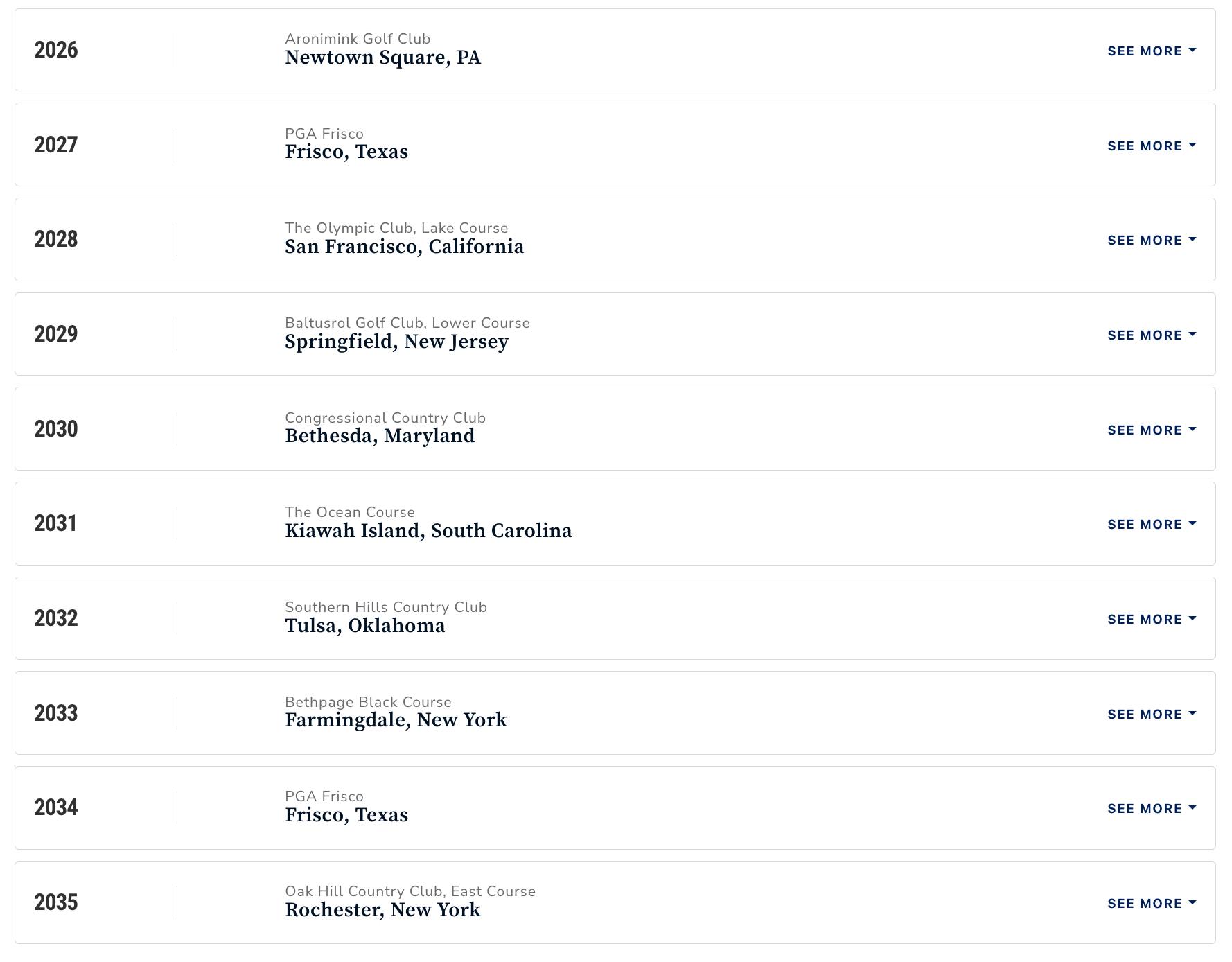
Looking ahead, the Olympic Club in San Francisco is prone to stubborn zero-visibility fog in May. Other announced venues will face concerns about winter kill and trying to jumpstart turf during cold, wet springs. The weather in Frisco could be anything. But who cares when you get to experience such majestic scenery?
Combine the murky venue options with the USGA locking down multiple elite courses into the 22nd Century, and there are only so many designs capable of handling the modern game in May.
The Cadence

“I don’t like it that short,” Nicklaus says of the 102-day span from April 9th’s first round of the Masters and the Champion Golfer Of The Year’s crowning on July 19th, 2026.
This year’s tennis Grand Slam events take place over a 245-day window. The Australian Open commences January 12th. The tennis quadrilateral wraps with the U.S. Open men’s final on September 13th.
While players have said the tighter major window of golf majors might improve the chances of someone playing for a Grand Slam at The Open, six years later most lament the lack of time between the majors in a world with added stresses caused by longer rounds, modern green speeds, and more intense scrutiny now that every shot is televised.
“It’s too condensed,” Justin Rose said in 2019 and a sentiment he’s reiterated since. “As a professional in terms of trying to peak for something, the process that’s involved in trying to do that can be detailed and it can be longer than a month. So that’s my reasoning for that.”
Rose’s take looks especially prescient almost seven years later.
“It’s pretty much driven by FedExCup, wanting to finish on a certain date, everything else having to fit in where it can.”
Ah yes, the Playoffs and justifying FedEx’s lavish nine-figure annual spend.
“For me a major championship should be the thing that is protected the most,” Rose said. “That’s how all of our careers ultimately are going to be measured. Thirty, 40 years ago there wasn’t a FedExCup so if you’re trying to compare one career to another career, Jack versus Tiger, it’s the majors that are the benchmarks. For them to be tweaked so much I think is quite interesting at this point.”
Then there is the effect on the stellar non-major championships played in late April, May and June. Some of the Tour’s best (now “Signature”) tournaments have been squeezed by a logjam of attractive playing options during the 73-day span also featuring the Masters, PGA and U.S. Open.
“I’d love to see [the majors] spread a little bit more only because it really concentrates too much emphasis on too short a period of time,” Nicklaus said at this year’s Masters. “There are too many other tournaments that are good tournaments that can sort of get shut out because of that.”
Nicklaus is understandably thinking of his Memorial Tournament. Two years ago Nicklaus agreed to play it the week before the U.S. Open because the Tour “had a thing they wanted to do,” and moved the RBC Canadian Open into the traditional Memorial slot.
